Fiction
and
Reality:
A Way
The
topic I wish to address today – the general relationship between
fiction and
reality – is one that is no doubt familiar to you all.
But
I’d
like
to
address
it
in a way that is rather
different from the ways it has been addressed up till now.
My
own
impression
is
that
debate
around this
topic
has become rather bogged down in recent years, and it seems to me it’s
time now
to pause and ask some fundamental questions about the issues at stake.
So that’s what I’d like to do – in the hope
that a new approach along the lines I will suggest might offer a way
out of
what is beginning to look suspiciously like an impasse.
The
question, then, is how we are to understand – to conceptualise – the
relationship between fiction and the so-called ‘real world’ or
‘reality’, and
in particular whether, and in what sense, fiction can be said to be a
source of
truth or knowledge about the real world. Most
of what I will say will relate to the
treatment of this issue by what is broadly termed analytic aesthetics,
but my arguments
also have implications for continental aestheticians, and towards the
end I
will add a brief comment under that heading as well.
***
Within
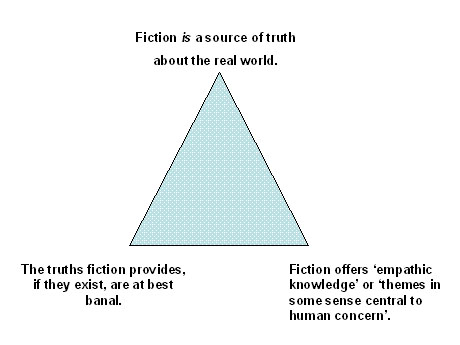
the analytic school, there seem to me to be three principal answers to
the
question I’m addressing.
First,
there are those bold enough to suggest that fiction is often
a source of truth about the real world and that, to quote one
writer of this persuasion, ‘some fictional works contain or imply
general
thematic statements about the world that the reader, as part of an
appreciation
of the work, has to assess as true or false.’[1]
Then, at the opposite pole, are those who
deny that fictional literature can tell us anything true about the real
world –
or who believe that if it does, the best we can expect are, in
Stolnitz’s
words, mere ‘garden variety’ truths which are, in his words,
‘distinctly
banal.’[2]
And finally, there is a third approach which tries to steer a middle
course between
these positions and claims, in language that characteristically tends
to be somewhat
nebulous, that fiction certainly furnishes truths about the real world
but they
are not ‘fact-stating’, ‘propositional truths’, like those of science,
but
truths of a different kind. Fiction,
as
one advocate of this view puts it, allows the reader to acquire
nonpropositional, ‘empathic beliefs and knowledge’ which then become
available
to apply in real life situations.[3]
Or in the words of Lamarque and Olsen, who
adopt a similar stance, what matters in fiction is not the truth or
falsity
of statements about human life but ‘[themes] which [are] in some sense
central
to human concern and which can therefore be recognised as of more or
less human
interest.’[4]
Thus,
there seems to be a triad of basic positions – the view that fiction is
a source of truth about the real
world; the view that, if it is, those truths are at best banal; and
then the
somewhat elusive claim that literature is about a special kind of truth
called ‘empathic
knowledge’ or ‘themes central to human concern’. As
I read the literature on this topic, all
participants tend to take up positions somewhere within the boundary
marked out
by this triad, but there is little sign of an emerging consensus about
which
position, precisely, is to be preferred. The
debate has being going on for quite some time now and
there’s more
than a hint that it has begun to stall – as if all positions
have been
thoroughly explored, and the best one can hope for is a kind of entente
cordiale based on a deftly worded compromise.
***
I
would like, today, to suggest a more radical course of action.
I think it’s often a useful step when a
debate reaches an impasse as this one seems to have done, to go back to
the
starting point, re-examine the question
one is asking, and see if there’s not something in the nature of the
question
itself that’s blocking progress. And
I
want to suggest that this in fact the case. I
want to suggest that there is an unexamined difficulty
lurking right
at the heart of the question which is hindering clarity of thought and
which,
if left unexamined, will simply go on fostering confusion and
disagreement. Let me explain.
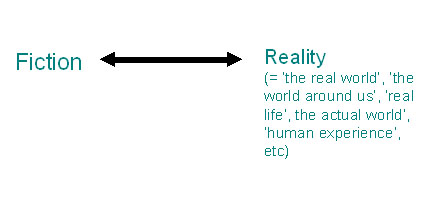
The
debate, as we’ve said, is about the relationship between fiction and
reality. So there are two
terms in our equation: on the one hand there are works of
fiction – such as Hamlet or Crime and
Punishment and many others –
and, on the other, there is something called ‘reality’ or perhaps ‘the
real
world’, or in alternative formulations sometimes employed, ‘the world
around
us’, or ‘real life’ or perhaps ‘human experience’.
At
first
sight,
this
seems
very
simple and
straightforward and we feel we’re ready to move straight on to whatever
the
next step might be. But in fact I
think
we need to pause right there because what we’ve said is not simple and
straightforward at all and we have already, perhaps without realising
it,
raised a very thorny question which we cannot afford to ignore.
Personally,
when I encounter the term ‘reality’ or an equivalent term of the kind
I’ve just
mentioned, in a philosophical analysis I usually begin to get uneasy.
What exactly do we understand by the
term? I
don’t mean:
does reality exist? I’m not asking the venerable philosophical question
about the
existence of the so-called external world. But
I am, nonetheless, acutely aware that ‘reality’ is one
of those chameleon-like
terms whose
meaning shifts in subtle but very important ways depending on the
context in
which it is used. So I need to know which
meaning, precisely, it is assuming in the present context – that is,
when we’re
speaking of the reality to which fictional literature is addressed.
I need
to
scrutinise
the idea and ensure that the meaning I’m ascribing to it is clear and
unambiguous,
and relevant to the context to which I’m applying it.
Because
if
I
don’t
do
that,
I’m simply embarking
on a philosophical analysis in which one of the key terms has been left
in a
conceptual limbo; and an analysis that begins in that way is obviously
destined
to achieve very little.
***
How
might
we clarify the idea? An
important first step in discovering what
we mean by the concept of ‘reality’ in the context of fictional
literature is to be clear as possible about what we do not
mean. And one way of
doing that is to compare literature
with other areas of intellectual endeavour – with history and politics,
for
example – and ask if the same understanding of the concept seems to
apply in those
cases, and, if not, what the differences might be.
Fortunately,
certain
writers
have
already
given
some
thought to this problem, and I’d like to spend a few moments
examining one analysis which strikes me as particularly insightful and
enlightening.
Early
in Stendhal’s novel La Chartreuse de
Parme, there is a celebrated scene set on the battlefield of
The
scene, as one astute critic points out, is a masterly depiction of the elusiveness,
from
the
point
of
view
of
the individual, of what one might conventionally call an ‘historical
event’. ‘When [he] describes
Fabrizio
searching for
the battle of
Stendhal
was
expressing, in his own nimble way, one of the great insights
of nineteenth century sensibility. It
was a flash of pure wonder at the utterly paradoxical relation between
an
individual destiny and whatever general significance might be attached
to an
‘historical event’. In fact, it was
the
splendid illustration of a myth which no historical venture, and no
amount of
sophistry, has thereafter been able to obliterate from our
consciousness…. The myth is about
man and
history: the more
naively, and genuinely, man experiences an historical event, the more
the event
disappears and something else takes its place: the starry sky, the
other man,
or the utterly ironical detail….[6]
The
key point is in those last lines: ‘the more naively, and genuinely, man
experiences an historical event, the more the event disappears...’
Recast to fit the terminology of our present
discussion,
the point might be formulated in the following way:
In
a
loose,
and
not
very
informative sense, literature and history can both
be said to be concerned with ‘reality’ or ‘the real world’.
But history’s focus is a collective
reality – the collective experience of men and
women. Like kindred
areas such as political or social thought, history’s concern is not an
individual’s thoughts and feelings in themselves
but only as
they are understood as part of a world in which people act upon, and
react to, one another. As a
conceptual possibility,
that is, history cannot be confined within the perspectives of an
individual life. It rests on an
intellectual schema
which cannot even begin to be drawn up without the initial resolve to transcend
the individual and his or her ‘private’ world of joys and sorrows, in
order to posit the existence of a collective world
which is
presumed to exist ‘among’ men and women when they act upon one another.
To state the matter in a paradoxical but
nevertheless
quite precise form, history concerns everyone, and for that
very
reason, concerns no one. This
is not of course
to imply that the events history records affect no
one. That claim would merely be
contrary to common sense. The point
is simply that the categories of historical
explanation – the concepts that claim to impose intelligibility and
meaning on the otherwise formless multiplicity of a collective event –
are, by their very nature, designed to illuminate something quite
different from the world as perceived and understood by the single
individual. Thus, to return to
Stendhal, Fabrizio
is unable to find the event called ‘the Battle of Waterloo’ which is in
fact raging all around him, and his attention constantly focuses on
seeming irrelevancies while a page of what we might quite reasonably
call ‘history’ is being written before his very eyes.
There
is
an
apparently
unbridgeable
gulf
– an ‘irretrievable disproportion’
as the critic I have been quoting calls it[7]
– between the forms of thought that confer meaning on a collective
event and the categories that shape the individual’s own experience.
Now,
this
analysis falls well short of a comprehensive account of the differences
between history and fictional literature. But
it
does, nevertheless, point to a crucial dividing line between their
fields of operation, and gives some initial shape and form to the
concept of ‘reality’ that applies in each case. The
‘reality’–, the ‘real world’, the ‘human experience’– with which
literature is concerned, the analysis suggests, is that of the living
human individual – the reality of the individual’s hopes, fears, joys
and sorrows. The reality of
history, by contrast,
is constituted on a plane that transcends the individual.[8]
There is, in other words, a fundamental difference
between
the reality with which fictional literature is concerned, and the
realities constructed by historical, social and political thought.
This conclusion, I should add, is in no way
inconsistent
with the obvious fact that certain works of fictional literature –
so-called ‘historical novels’ for example –sometimes incorporate
episodes from history, and occasionally even historical figures
(Napoleon being an obvious example). But
such works
characteristically make use of historical events as part of their plot
or setting , and there is a major difference between that and the quite
different proposition of attempting to close the gap between the
perspectives of individual experience and the categories of historical
explanation. So the mere fact that
history makes
periodic appearances in works of fiction is not an objection to the
claim I am advancing. It remains
the case, as I
have argued, that the ‘realities’ – the ‘real worlds’ – addressed by
literature and by history are of quite different kinds,
and to
confuse the two, or assume that they do not need to be distinguished –
as many theorists do – would be to ignore a crucial feature of the
concept of reality relevant to fictional literature.
It
would
in
effect
be
to
send the concept back to the definitional limbo
of which I spoke earlier.
***
Now,
I see
this analysis as an important first step in clarifying the notion of
reality in the context of fictional literature and I want to return to
these ideas in a moment. But before
doing so, I
would like, very briefly, to take the analysis a step further by
drawing another comparison – this time not between literature and
history, but between literature and science.
Debates
about
the relative importance of literature and science are not new.
One well-known episode is the ‘Two Cultures’
controversy
of the 1960s; another was the so-called ‘science wars’ debate of the
1990s which, while concerned principally with science itself, also had
implications for literature and for the humanities more generally.
One familiar line of argument in these debates goes
something like this: “Science aims
to give us an
account of reality based on objective evidence – evidence whose
validity is verifiable through public processes of experimentation and
demonstration. The reality of which
fictional
literature speaks, on the other hand, is much more questionable.
Literature has no equivalent to science’s public
tribunal
of experimental verification, and the knowledge it provides – if one
can call it knowledge – cannot be described as objective.”
Advocates
of
this
line
of
argument
might perhaps concede that, at their best,
works of literature give us an author’s sincere and carefully observed
view of the world, and this may intrigue or entertain us; but
ultimately, they would argue, the ‘reality’ in question is simply a
reality perceived by the author: it is necessarily only ‘subjective’.
As
I say,
this argument is a familiar one and I’m sure you’ve heard it many times
before. Yet familiar though it is,
it has a rather
irritating persuasiveness. We’d
like very much to
dismiss it as facile and superficial but where exactly is the flaw?
Where does it go wrong?
It
goes
wrong, in my view, through an ambiguity lurking within those over-used
terms ‘subjective’ and ‘objective’ – and I think it’s very instructive
to reflect on that ambiguity for a moment.
Our
comparison between fictional literature and history,
you’ll
recall, suggested that the focus of literature is the world as
perceived and understood by the single individual – the reality of the
individual’s hopes, fears, joys and sorrows. History’s
focus
was
the
collective
reality
presumed to exist ‘among’ men and
women as they act upon one another – a reality which necessarily
transcends the individual. Neither
‘reality’, we
recall, emerged as more ‘subjective’ or ‘objective’ than the other;
they were distinguished simply by this individual/collective contrast.
Now,
what
exactly gives rise to the persistent tendency to associate science with
the idea of ‘objectivity’? In my
view, the reason
is very largely the methodology to which I have referred – science’s
well known procedures of experimentation, openness to public scrutiny
by peers, and willingness to have experiments repeated by others.
But, if we reflect on it, is ‘objectivity’ the best,
most
accurate, term to describe what takes place in such contexts?
The feature of this methodology that’s even more
obvious –
so obvious, in fact, that we easily take it for granted and overlook it
– is the importance placed on the impersonal nature
of the
processes employed and of the knowledge thus acquired – that is, the
importance of being able to reach the same conclusion irrespective
of who is asking the question. Like
history,
though in a different way, and for different reasons, science also
seeks
to
free
itself
from
anything
dependent on the perspective of the single
individual. Francis Bacon, that
well known early
advocate of the scientific method, wrote that one of the
‘illusions
which
block
men’s
minds’
is
that brought about by ‘the individual
nature of each man’s mind and body; and also in his education, way of
life and chance events’.[9]
Viewed from the standpoint of science, in other
words, the
individual, with what are regarded as his or her ‘merely personal’
perceptions, is a potential source of distortion
rather than of
knowledge. The
ideal perspective for
science is quite deliberately no-one’s perspective:
it is, so
to speak, a ‘public’ perspective, and the reality it pursues is, as a
matter of principle, an entirely impersonal reality.
The
danger of
the terms ‘objective’ and ‘subjective’ in drawing distinctions between
science and literature is not in other words that they are entirely
irrelevant – because they are not – but that they can so easily be
misleading. While capturing to
a degree the
idea of impersonality, the term ‘objective’ can also very
easily suggest the idea of ‘correspondence with the facts’, or ‘what
reality is truly like’. ‘Subjective’,
similarly,
can suggest not just that which owes its origin and nature to
individual experience, but that which may also be biased and therefore
unreliable. Once we clear those
confusing
ambiguities away, however, we see that we are really dealing with intellectual
enterprises of quite different kinds.
Literature,
we
see,
is
concerned
with
the reality of the single individual’s
perceptions and understandings (which, incidentally, will also include
his misperceptions and misunderstandings).
Science
explores
a
reality
which
systematically
aims to exclude anything of
that nature. Both could with equal
justice claim to
be describing ‘what reality is truly like’ because they are looking at
what are, in terms of human understanding, two quite different kinds of
realities.
Of
course,
this analysis makes no more claim to provide a full account of the
methodology of science than the earlier discussion did to provide a
comprehensive analysis of the theory of history. The
comparison
with
science
does,
nevertheless,
throw further light on the
very troublesome issue raised in the introductory section of this paper
– the multiple meanings of the term ‘reality’ and of equivalents such
as ‘the real world’ or ‘the world around us’. The
reality addressed by science, the analysis suggests, is a specific kind
of reality, just as the reality of history is of a specific kind – and
both differ from the reality addressed by fictional literature.
Both science and history, albeit for different
reasons,
are obliged, as a matter of principle, to shun the domain of the
individual or the ‘merely personal’. For
literature, by contrast, the ‘merely personal’ is a sine qua
non
of its existence.
***
I
would now
like, very briefly, to draw out certain implications of this analysis
for current debates about fiction and reality. As
I
indicated earlier, most of what I say will relate to analytic
aesthetics, but I will say a little about continental aesthetics as
well.
How,
we
first
need
to
ask,
do writers in the analytic sphere define the
concept of reality in their deliberations on the relationship between
fiction and reality? I regret to
say that in my
reading of the relevant material I find very little attempt to define
the concept at all. One encounters
various cursory
formulations which are used as synonyms – such as ‘the actual world’,
‘the rest of the world in which [aesthetics objects] exist’ (that
variant is Monroe Beardsley’s) and even Stolnitz’s rather odd phrase,
‘the great world’. But obviously
none of that
really tells us anything more than the terms ‘the real world’ or
‘reality’ do in the first place. Certainly,
there
is nothing to give us any guidance on the issues I have raised in my
analysis.
So,
in the
absence of any explanation, we are, I think, obliged to draw our
conclusions from the way the term ‘reality’ is used.
That
is,
we
need
to
look
at particular treatments of the relationship
between fiction and reality offered by analytic thinkers and ask: what
kinds of phenomena do these writers cite as examples
of the
‘reality’ to which fictional literature is said to relate, and what can
we deduce from these examples about the notion of reality they seem to
have in mind?
I’m
sure you
can think of many instances yourselves; but the examples I have found
in discussions by analytic aestheticians of what is meant by ‘reality’
or the ‘real world’ include the following:
·
Whether
it is raining
outside
·
The
fact
that
General
Blucher
arrived
late at
·
Whether
or not a real
Sherlock
Holmes existed [and variants of this idea]
·
That
summer
is
warmer
than
winter
It
is, I
think, fairly difficult to infer any very clear definition of the
concept of reality from these examples but I am nevertheless going to
hazard what I think is an educated guess. I
believe
that the implied concept of ‘reality’ or ‘real world’ underlying
examples such as these is not very far from the concept of reality I
have identified in the case of science. The
examples, if we examine them, all suggest states of affairs that anybody
could verify – that is, an impersonal, ‘public’ reality which is, as
far as possible, independent of the perspective from which it is viewed.
Certainly, these examples don’t really evoke the
idea of
scientific methods of verification – propositions of this kind are,
after all, much simpler than those that science normally addresses –
but, it is interesting and revealing, I think, to see that we can easily
add one or two elementary scientific propositions to the list and find
that they do not seem out of place. [The
list
above
was
shown
on
a PowerPoint slide. At this point, I showed the
same slide with the following two additions:
- "That the earth
revolves around the sun;
- That the heart
pumps blood around the body." See
image at right.]
You
can no
doubt see now where I’m going with this, so I won’t labour the point
too heavily. If it is true, as I
have argued, that
a work of fictional literature, such as Hamlet or Crime
and
Punishment, addresses a reality of a specific kind which is not
the impersonal reality of science – any more than it is the collective
reality of history – ought we really be surprised that analyses that
assume the contrary seem, as we noted earlier, to be making little
headway and to be caught in an impasse? One
commentator has written recently that the relationship between fiction
and reality is a problem that ‘has proved remarkably resistant to
satisfactory resolution’[10]
which is perhaps a more diplomatic way of expressing the point. But
however
we
describe
the
situation,
the cause, in my view, is fairly
clear. The debate has resisted satisfactory resolution because it is,
in effect, trying to fit literature into a world in which it simply
does not belong – a world viewed from an impersonal
vantage-point, made up of publicly demonstrable facts, a world which,
as a matter of principle, needs to treat the single individual’s
perspective as not just as inadequate but even suspect. Asking
what
fictional
literature
can
tell
us about a reality of this kind is
guaranteed to lead us into an impasse for the quite simple reason that
literature is, by its very nature, addressed to a reality of a quite
different kind.
***
I
mentioned
earlier that I would also say a word about continental aesthetics but
it will be very brief. Continental
and analytic
aesthetics tend, as we know, to adopt very different approaches to
their subject matter but one feature they share is that theoretical
analyses in both contexts make extensive use of the notion of
‘reality’; and continental aesthetics, like its analytic counterpart,
is apt to comment frequently on the relationship between literature and
‘reality’, or ‘real world’.
Early
in his Aesthetic
Theory, Theodore Adorno, for example, writes that
Tied
to the
real world, art adopts the principle of self-preservation of that
world, turning it into the ideal of a self-identical art … It is by
virtue of its separation from empirical reality that the work of art
can become a being of a higher order…[11]
I
should be
honest and confess that I do not know precisely what this somewhat enigmatic statement
means, but I do note that it seems to rely heavily on concepts termed
‘the real world’ and ‘reality’ – the word
‘empirical’ adding very little in my view. Now,
nowhere in his Aesthetic Theory, as far as I can
tell, does
Adorno provide a clear definition of what he has in mind when he uses
these terms, so, as with analytic aesthetics, I am obliged to infer his
meaning from the contexts in which the terms are used.
This
quote
is
taken
from
an
early section of Aesthetic Theory headed
‘On the relation between art and society’ and that
in itself, I
think, is very revealing. In fact,
as one reads
through Adorno’s text, one repeatedly has the impression that when he
uses terms such as ‘the real world’ or ‘empirical reality’, he means a social
reality, or perhaps a socio-cultural reality, of some kind – but in any
event a collective reality – a reality understood,
as I said in
my earlier discussion of this issue, in terms of the collective
experience
of
men
and
women.
This,
I
should add, seems to be a prominent characteristic of much continental
theory, especially of
You
can, I
imagine, readily anticipate what I want to say about this.
Areas
of
continental
aesthetics
influenced
by
thinking of this kind seem to
me to suffer from the same problem I have identified in the analytic
approach – albeit for a different reason. Once
again, we see an attempt to yoke fictional literature to a reality
which is not its essential concern – in this case, a reality which, as
I argued earlier in my discussion of Stendhal, is, as a matter of
principle, separated from the world of fictional literature by an
unbridgeable gulf – an ‘irretrievable disproportion’.
In
analytic
aesthetics,
I
have
argued,
the debate seeks to link fiction to
a semi-scientific reality, a reality made up of the impersonal,
publicly demonstrable fact. Large
areas of
continental aesthetics, I would argue, attempt to link literature to a
reality which is just as alien – the world of collective experience
which, as we saw, is also, by its very nature, obliged to transcend the
world of the single individual.
***
One of the central challenges facing modern aesthetics – continental or analytic – is, in my view, to develop a theory of literature – and of art generally – that overcomes the fundamental problem analysed in this paper. Firstly, it is crucial in my view to recognise that the concept of ‘reality’, ‘the real world’ etc must not be left in a conceptual limbo and waved away with cursory phrases such as ‘the world around us’, ‘the actual world’, ‘the rest of the world in which [aesthetics objects] exist’, or ‘the great world’. The nature of the reality to which literature is addressed needs to be analysed and defined. It needs to be given the same degree of philosophical precision we would expect in any other part of our analysis – especially given that it is one of the two key elements in our equation. Secondly, I believe we need to recognise clearly that the reality to which literature – and all art – is addressed is a reality of a specific kind – which I have called, in very summary and general terms, the reality of the living individual, as distinct from the impersonal worlds of science or history. We need, in short, to situate literature in the context in which it rightly belongs and cease seeing it as a competitor in areas in which it has no essential place.
That
of
course is only a beginning. The
real challenge,
once having taken those steps, is to develop a theory of literature and
art that builds on this foundation – a theory based firmly on the
recognition that the reality to which art is addressed is a reality
perceived and understood by the single individual.
I
know
of
only
one
theorist
in recent times who has done this and that is
the much-neglected French theorist André Malraux, and those of
you who are familiar with his work will know that it offers us a
perspective on the world of art and literature very different from that
offered by analytic or continental aesthetics. But
my time has run out and I don’t intend to say anything more about
Malraux than that. I mention him
only because you
may perhaps think that my strictures against the analytic and
continental approaches leave us with a rather empty and desolate
landscape with nowhere else to go. I
think there is
an alternative. I think it is
perfectly possible to
develop a theory of literature and art which is based squarely where it
should be and which avoids the pitfalls I have described.
And
I
think
that
if
we
are to make real progress – and emerge from our
present impasse – that is the challenge that lies before us.
4 Peter Lamarque and Stein Olsen, Truth, Fiction and Literature, A Philosophical Perspective, (Oxford: Clarendon Press, 1994), 332, 450.
5 Stendhal, La Chartreuse de Parme, Stendhal, Romans et Nouvelles (2) (Paris: Gallimard, 1952), 59-65. Fabrizio says to one of the French sergeants, ‘Sir, this is the first time I have been present at a battle. But is this a real one?’ (p.65)
8 This does not imply that literature is necessarily always concerned with individual differences (as suggested, for instance, in Rousseau’s well-known claim that Nature ‘broke the mould’ in which he was formed). The enormous range of human types which literary works present suggest on the contrary that the ‘categories that shape the individual’s experience’, to use the terminology I employed a moment ago, can take an endless variety of forms and need not revolve around a special value attached to an individual’s distinctive characteristics.
Another version of the paper,
entited Literature and
Reality, was
published in Journal
of European Studies,
Vol 31, Part
2, No 122, June 2001
I restated some of these ideas in a paper entitled Art and 'the real world' given at the 37th congress of the Australasian Universities Language and Literature Association (AULLA) at the University of Queensland on 10-12 July 2013.
...
debate around
this topic has become rather bogged down in recent years, and it seems
time now to pause and ask some fundamental questions about the issues
at stake.
Within
the analytic
school, there seem to be three principal answers to the question ...
... there
is an
unexamined difficulty lurking right at the heart of the question which
is hindering clarity of thought and which, if left unexamined, will
simply go on fostering confusion and disagreement.
Two terms in the
equation...
... ‘reality’ is one of those chameleon-like
terms whose
meaning shifts in subtle but very important ways depending on the
context in which it is used.
One
way of of
clarifying
the concept of ‘reality’ in the context of fictional literature is
to compare
literature with other areas of intellectual endeavour – with history
and politics, for example – and ask if the same understanding of the
concept seems to apply in those cases, and, if not, what the
differences might be.
‘the
more naively, and genuinely, man experiences an
historical event, the more the event disappears...’
There
is an apparently unbridgeable gulf – an
‘irretrievable disproportion’ – between the forms of thought that
confer meaning on a collective event and the categories that shape the
individual’s own experience.
...
the
‘realities’ – the ‘real worlds’ – addressed by literature and by
history are of quite different kinds, and to
confuse the two,
or assume that they do not need to be distinguished – as many theorists
do – would be to ignore a crucial feature of the concept of reality
relevant to fictional literature. It
would in
effect be to send the concept back to a definitional limbo.
What exactly gives rise to the persistent
tendency to
associate science with the idea of ‘objectivity’?
Like
history, though in a different way, and for
different reasons, science also seeks to free
itself from
anything dependent on the perspective of the single individual.
Literature
is concerned with the reality of the single
individual’s perceptions and understandings (which will include his misperceptions
and misunderstandings). Science
explores a
reality which systematically aims to exclude anything of that nature.
Both
science and history, albeit for different reasons,
are obliged, as a matter of principle, to shun the domain of the
individual or the ‘merely personal’. For
literature, by contrast, the ‘merely personal’ is a sine qua
non
of its existence.
How
do writers in the analytic sphere define the concept
of reality in their deliberations on the relationship between fiction
and reality? In my reading of the
relevant
material, I find very little attempt to define the concept at all.
...
in the absence of any explanation, we are obliged to
draw our conclusions from the way the term ‘reality’ is used.
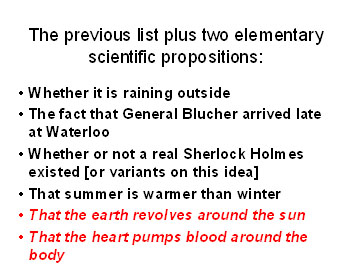
I
am led to surmise that the notion of ‘reality’ or the
‘real world’ that many writers in the analytic tradition have in mind
in discussing the relationship between fictional literature and reality
is very much like that of science – that is, it is describable in
statements (like whether or not it is raining outside) that will be
true or false irrespective of who might be testing their veracity.
The
debate has resisted satisfactory resolution because
it is, in effect, trying to fit literature into a world in which it
simply does not belong – a world viewed from an impersonal
vantage-point, made up of publicly demonstrable facts, a world which,
as a matter of principle, needs to treat the single individual’s
perspective as not just as inadequate but even suspect. Asking
what
fictional
literature
can
tell
us about a reality of this kind is
guaranteed to lead us into an impasse for the quite simple reason that
literature is, by its very nature, addressed to a reality of a quite
different kind.
Seldom,
once again, [in continental aesthetics] is the
question addressed in any explicit way, but there
is a constant
underlying suggestion that the reality to which art is addressed is
understood as a political, historical or cultural reality – that is, a
collective reality of some kind.
In
analytic
aesthetics, the debate seeks to link fiction
to a semi-scientific reality, a reality made up of the impersonal,
publicly demonstrable fact. Large
areas of
continental aesthetics, attempt to link literature to a reality which
is just as alien – the world of collective experience which is also, by
its very nature, obliged to transcend the world of the single
individual.
Firstly,
it is crucial to recognise that the concept of
‘reality’, ‘the real world’ etc must not be left in a conceptual limbo
and waved away with cursory phrases such as ‘the world around us’, ‘the
actual world’, ‘the rest of the world in which [aesthetics objects]
exist’, or ‘the great world’.
Secondly, we need to recognise that the reality to which literature –
and all art – is addressed is a reality of a specific kind – which I
have called, in very summary and general terms, the reality of the
living individual, as distinct from the impersonal worlds of science or
history. We need, in short, to
situate literature
in the context in which it rightly belongs and cease seeing it as a
competitor in areas in which it has no essential place.
The real challenge, once having taken those steps, is to develop a
theory of literature and art that builds on this foundation – a theory
based firmly on the recognition that the reality to which art is
addressed is a reality perceived and understood by the single
individual.
It is perfectly possible to develop a theory of literature and art
which is based squarely where it should be and which avoids the
pitfalls I have described. And if
we are to make
real progress – and emerge from our present impasse – that is the
challenge that lies before us.